
Technology claims guide
Underwear Technology Claims: What OEM Buyers Should Verify
Translate cooling, moisture-management, odor-control, pouch and sustainability language into testable product specifications and approval evidence.

Decisions this guide helps you control
Replace trend language with a measurable product requirement.
Connect material data, test method, sample and production lot to the exact claim.
Approve market-facing language only within the verified scope.
In this guide
Underwear technology claims should be treated as specification and evidence questions, not marketing shortcuts. Terms such as cooling, moisture-wicking, odor-resistant, breathable, ergonomic or sustainable can describe very different materials and constructions. B2B buyers should define the intended function, evidence route, product version and permitted wording before a claim reaches packaging or a product page.
Underwear technology claims: the short answer
Write the precise function expected from the garment, identify the material or construction that creates it, agree the relevant test or evaluation method, and confirm that the evidence applies to the final product version. Approve wording that stays within the evidence. A supplier sheet, raw-material result or sample impression should not automatically become a finished-garment performance claim.
Claim–evidence–approval matrix
| Claim area | Evidence question | Approval control |
|---|---|---|
| Cooling or cool touch | Is the claim about initial contact, heat transfer, drying, ventilation or wearer perception? | Name the function and method; avoid an unsupported temperature or duration. |
| Moisture management | Which transport, absorption, spreading or drying behavior is required? | State whether evidence applies to fabric or finished garment. |
| Odor or antimicrobial | Is the mechanism odor management, antimicrobial activity, or both? | Keep the terms separate and confirm legal/market requirements. |
| Ergonomic pouch | Which dimensions, panels, seams and fit outcome are being approved? | Use pattern, wear evaluation and construction evidence. |
| Sustainability | What exact fiber, recycled content, chain of custody or impact statement is claimed? | Verify documentation and wording for the exact product and market. |
Testing, labeling and advertising requirements vary by claim, market and product. Sunin does not make a certification, antimicrobial percentage, temperature reduction or sustainability claim without current project-specific evidence and approval.
1. Define the intended function before choosing the claim
Start with the user and product need. Does the buyer want a cooler initial touch, faster drying after exercise, more airflow through a panel, less cling when damp, a more stable pouch or documented recycled content? These are different requirements.
Write the function in the development brief before selecting a material or marketing phrase. This helps the supplier propose a construction and evidence plan instead of reverse-engineering a vague claim.
First define the product, method and evidence. Then write the shortest claim that accurately reflects them.
2. Separate the different meanings of “cooling”
“Cooling” may refer to cool-touch sensation, thermal transfer, moisture evaporation, ventilation, fabric weight or subjective comfort. A mesh panel can increase openness, while a smooth fiber can influence hand feel; neither automatically proves a quantified body-temperature reduction.
Ask what is measured, on which specimen, under what conditions and for how long. If the project relies on a supplier’s material data, confirm the exact material version and whether the final dyeing, finishing and garment construction remain within scope.

3. Define moisture management precisely
Absorption, wicking, spreading and drying are related but not identical. A buyer should identify which behavior matters for the end use and avoid treating one raw-material statement as proof of every moisture-management outcome.
| Question | Why it matters |
|---|---|
| What is the specimen? | Fabric and finished garments may produce different evidence. |
| What is the method? | Results are meaningful only inside a defined procedure. |
| What is the benchmark? | A comparison needs an approved control or requirement. |
| What changed in production? | Color, finish, GSM or construction changes may affect relevance. |
4. Keep odor-control and antimicrobial claims separate
Odor management can involve moisture control, drying, adsorption or another material mechanism. Antimicrobial language refers to biological activity and may create different test, legal and labeling obligations. Do not use the terms interchangeably.
Before approving either claim, identify the active mechanism, test specimen, method, result, durability condition, market and allowed wording. Avoid inventing a percentage reduction or number of wash cycles.
5. Verify ergonomic pouch claims through construction and fit
An “ergonomic” pouch can involve panel shape, seam direction, gusset, lining, stretch distribution and size grading. The evidence should show the exact approved construction, not a generic pouch category.
Use dimensioned patterns, garment measurements, fit comments and wear evaluation across the intended size range. Claims such as support, separation or reduced friction should be defined carefully so the approved language matches the product experience being evaluated.
6. Break sustainability language into verifiable statements
“Eco-friendly” is too broad for a production specification. Identify the exact statement: fiber identity, recycled content, packaging material, certified chain of custody, restricted-substance requirement or another measurable attribute.
Check the document owner, scope, validity, transaction or lot relevance where applicable, and whether the final product and market-facing claim are covered. Do not publish a certification logo or claim because a similar material once carried it.
7. Build a performance brief before sampling
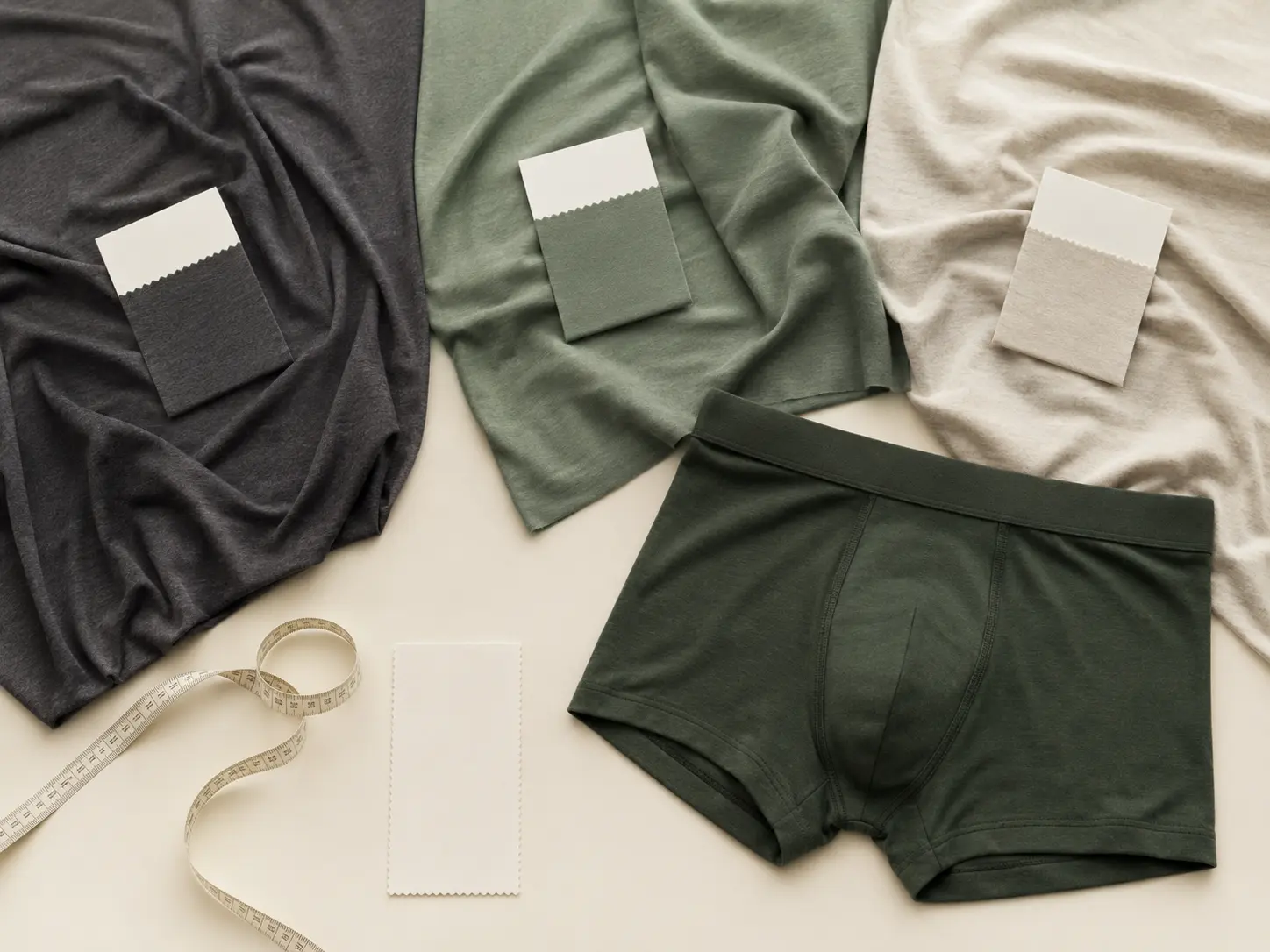
The brief should connect the intended function, target user, garment style, material, construction, care conditions, test or evaluation method, comparison basis, required documents and approval owner. Mark open questions rather than filling them with unsupported numbers.
- Exact claim under consideration
- Feature or material creating the function
- Test specimen and production version
- Method and comparison basis
- Durability or care condition
- Market and labeling requirement
- Evidence owner and validity
- Approved final wording
8. Approve the production specification—not only the claim
After sample approval, freeze the fabric version, GSM direction, finish, panel and pouch construction, print or treatment, care instruction and evidence references. Any substitution should trigger a documented impact review before the claim continues.
Keep marketing, packaging, e-commerce and quality teams aligned to the same approved version. If the evidence cannot support the desired wording, narrow the wording or remove the claim rather than stretching the interpretation.
Frequently asked questions
Does moisture-wicking mean the underwear is cooling?
Not automatically. Moisture transport and cooling perception are different functions and should be specified and supported separately.
Can a raw-material certificate support a finished-garment claim?
Only within its scope. Confirm the exact material, processing, product version, validity and whether the wording applies to the final garment.
Is “odor-resistant” the same as antimicrobial?
No. The mechanisms, evidence and legal implications can differ. Define and verify the intended claim.
How should an ergonomic pouch be approved?
Use controlled pattern and construction details, measurements, fit evaluation and size-range review for the exact product.
Can Sunin publish sustainability certifications for every product?
No. Any certification or sustainability claim requires current, product-specific documentation and approved wording.
Make every technology claim traceable.
Connect the feature, product version, method and approved wording before the claim reaches market.