
Supplier evaluation guide
How to Choose a Reliable Men’s Underwear Manufacturer in China
Choosing a men’s underwear manufacturer is not only a price comparison. The supplier must understand stretch fabrics, body fit, waistband development, size grading, sewing construction and repeated bulk production.
Decisions this guide helps you control
A general garment factory may be able to sew underwear, but specialist production experience matters. Boxer briefs and trunks require controlled stret…
Different specifications create different prices. A quotation for a basic cotton trunk cannot be compared with a modal boxer brief using a custom jacq…
A sample is a development tool. It should confirm the fabric, fit, construction, waistband, logo position and workmanship before the factory commits m…
In this guide
- 011. Check Whether the Factory Specializes in Your Product Category
- 022. Give Every Supplier the Same Product Brief
- 033. Evaluate the Sampling Process, Not Only the Sample Price
- 04A reliable sample process should include
- 054. Confirm the Real MOQ Structure
- 06Warning signs
- 075. Compare Fabric Knowledge and Material Control
- 086. Check Fit Development and Size Grading
- 097. Review Quality Control and Bulk Consistency
- 108. Assess Communication Before You Assess Promises
- 119. Use a Supplier Comparison Scorecard
- 12Conclusion
- 13Frequently asked questions
Choosing a men’s underwear manufacturer is not only a price comparison. The supplier must understand stretch fabrics, body fit, waistband development, size grading, sewing construction and repeated bulk production. A low quotation is not useful if the sample does not fit your market or the bulk order cannot match the approved sample.
For private label brands, the most reliable evaluation method is to compare suppliers through the same product brief. Confirm the style, fabric, approximate quantity, colors, size range, waistband, logo, packaging and delivery destination before asking for a final quotation.
1. Check Whether the Factory Specializes in Your Product Category
A general garment factory may be able to sew underwear, but specialist production experience matters. Boxer briefs and trunks require controlled stretch, accurate elastic tension, comfortable seams and stable size grading. Small construction differences can affect leg riding, waistband slipping, pouch support and durability.
Ask the supplier which men’s underwear styles they produce regularly. A suitable factory should be able to discuss boxer briefs, trunks, briefs, loose boxers, long-leg styles and different pouch constructions in practical terms.
Useful questions to ask
- Which underwear styles are produced regularly?
- Can the factory work from a tech pack, reference sample or existing pattern?
- Can it adjust the fit for EU, UK, US or Australian size standards?
- Does it make samples before bulk production?
- Which parts of production are completed internally and which are outsourced?
2. Give Every Supplier the Same Product Brief
Different specifications create different prices. A quotation for a basic cotton trunk cannot be compared with a modal boxer brief using a custom jacquard waistband and retail box. Before comparing prices, provide the same information to every supplier.
| Specification | Information to provide |
| Style and fit | Boxer brief, trunk, brief, loose boxer, long leg, pouch or fly construction |
| Fabric | Composition, weight, stretch, color and any compliance requirement |
| Quantity | Total quantity, number of styles and number of colors |
| Sizes | Size range and approximate quantity by size |
| Waistband | Width, color, logo method and artwork |
| Branding | Care label, size label, heat transfer, silicone or embroidery requirements |
| Packaging | Individual bag, insert card, multi-pack or retail box |
| Trade term | EXW, FOB, CIF or DDP and delivery destination |
3. Evaluate the Sampling Process, Not Only the Sample Price
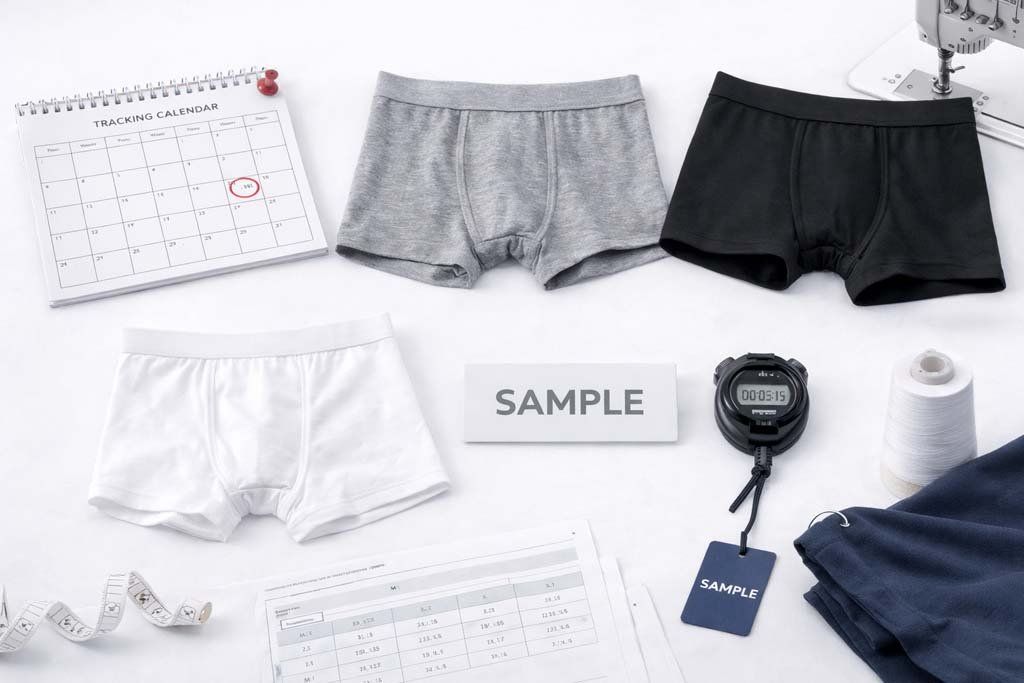
A sample is a development tool. It should confirm the fabric, fit, construction, waistband, logo position and workmanship before the factory commits materials for bulk production.
Stock-fabric samples can be faster, while a fully customised sample may take longer because the waistband, fabric color, print or trims need separate development. For a typical private label project, the factory should explain which details will be final and which details are only temporary references in the first sample.
A reliable sample process should include
- A written specification summary before sampling
- Clear explanation of sample fees and courier charges
- Photos or measurements before shipment when appropriate
- A structured feedback list after fitting
- A final pre-production sample when major details change
4. Confirm the Real MOQ Structure
The sewing quantity is only one part of an underwear MOQ. Fabric dyeing, print setup, custom elastic, size distribution, labels and packaging can each create a separate minimum.
At Sunin, the usual starting point for custom men’s underwear is around 1,000 pieces per style. Depending on the fabric, waistband and design, the quantity may be divided across two or three colors. The workable structure must be confirmed from the complete specification rather than from the total number alone.
Warning signs
- A supplier confirms an extremely low MOQ before reviewing the waistband or fabric requirements.
- The quotation does not state whether the MOQ is per style, per color or per fabric.
- The supplier promises custom-dyed fabric and custom jacquard elastic for a very small order without explaining extra costs or leftover material.
- The size distribution is not discussed before production.
5. Compare Fabric Knowledge and Material Control
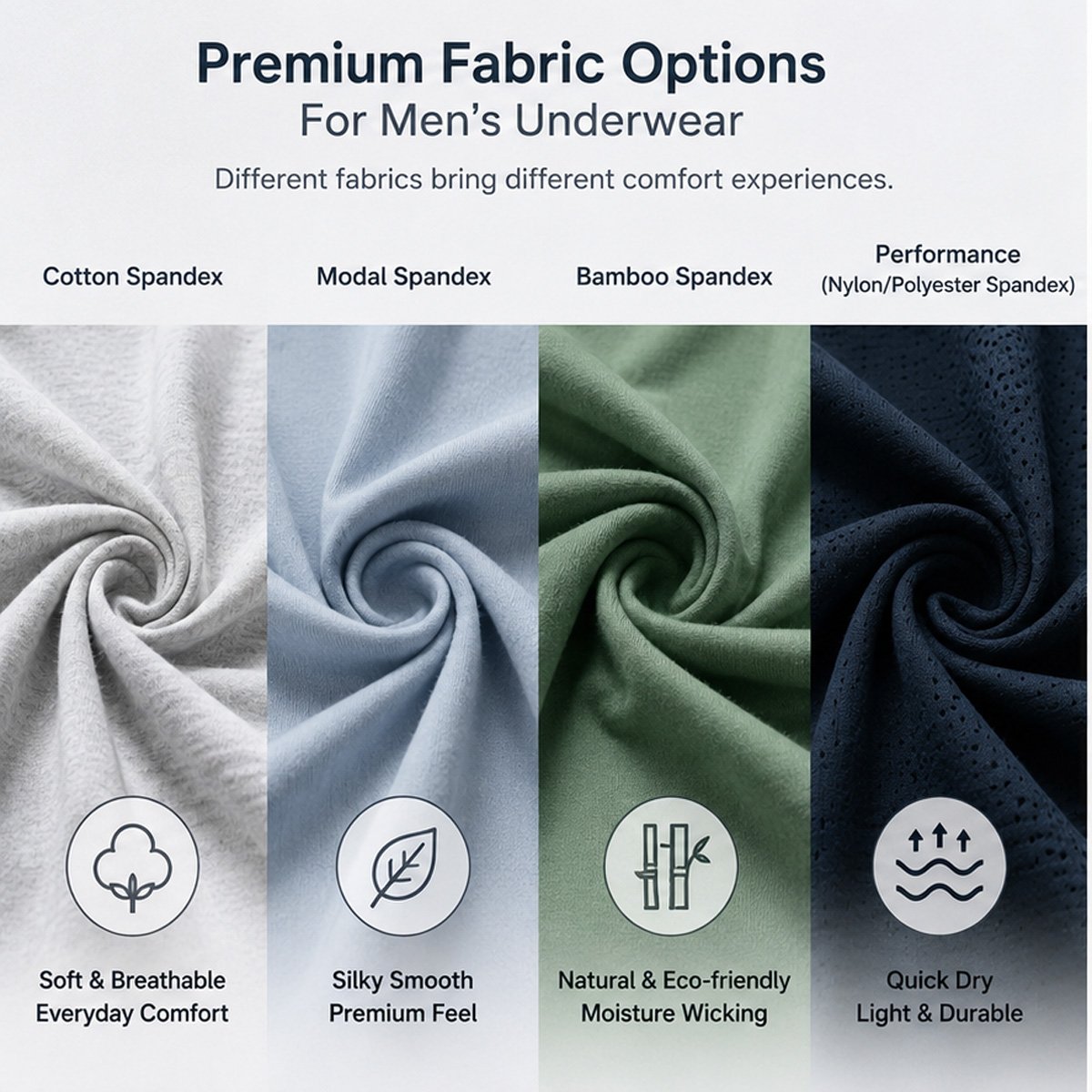
For daily underwear, common options include cotton/spandex, modal/spandex and bamboo viscose/spandex. Performance collections may use nylon or polyester blends. The right fabric depends on softness, recovery, breathability, print method, target price and intended use.
Ask for composition, fabric weight, usable width, shrinkage, colorfastness and recovery information. If a certification is required, confirm whether it applies to the exact fabric and order rather than relying on a general factory statement.
6. Check Fit Development and Size Grading
A visually attractive sample can still fail if the waistband slips, the legs ride up, the pouch compresses the body or the size grading is inconsistent. Fit evaluation should include wearing, movement and repeated washing—not only flat measurements.
For a new market, provide a competitor sample or an approved size chart. The factory can then compare the rise, inseam, leg opening, waistband length and pouch construction with the intended customer profile.
7. Review Quality Control and Bulk Consistency
Ask how the factory controls incoming fabric, cutting, sewing, waistband tension, measurements, stains, broken stitches, packaging and final inspection. Quality control should be connected to the approved sample and written specifications.
AQL terminology can be useful, but the inspection checklist is more important. Agree on the critical measurements and unacceptable defects before production.
8. Assess Communication Before You Assess Promises
Good communication is a production control tool. A reliable supplier should identify missing information, explain trade-offs and avoid confirming an unrealistic price or lead time before the product is clear.
Pay attention to whether the salesperson answers your actual questions, records changes correctly and gives one clear next step. This behaviour during sampling usually reflects how the bulk order will be managed.
9. Use a Supplier Comparison Scorecard
Price should be considered together with technical understanding, sample accuracy, responsiveness, material control, quality process and commercial transparency.
| Evaluation area | Suggested weight |
| Product and fit expertise | 20% |
| Sample accuracy | 20% |
| Fabric and trim control | 15% |
| Quality control process | 15% |
| Communication and documentation | 15% |
| Price and payment terms | 10% |
| Lead time and delivery planning | 5% |
Conclusion
The right men’s underwear manufacturer should help you reduce development risk, not simply provide the lowest unit price. Use a complete specification, compare samples under the same conditions and confirm the MOQ, materials, fit, quality process and commercial terms in writing.
Planning a private label men’s underwear project? Send Sunin your target style, fabric, quantity, size range, waistband and packaging requirements. Our team will review the specifications and advise on a practical development route.
Frequently asked questions
Practical answers for product development and procurement decisions.
What information is needed for an accurate underwear quotation?
Provide the style, fabric, quantity, colors, sizes, waistband, logo, packaging and trade term. A reference sample or tech pack is also helpful.
Should I choose the cheapest manufacturer?
Not automatically. Compare the final specification, sample accuracy, quality process and total landed cost. A cheap quotation may exclude important materials or development work.
Can a new brand make samples before placing a bulk order?
Yes. Sampling is the practical way to confirm fit, fabric and workmanship before bulk production.
What is a typical MOQ for custom men’s underwear?
It varies by fabric and trims. Sunin’s usual starting point is around 1,000 pieces per style, with the color structure confirmed after reviewing the full design.
Related resources
Planning a men’s underwear project?
Share the style, expected quantity, fabric, colors, sizes, waistband, packaging and destination already known.