
Private label launch guide
How to Start a Men’s Underwear Brand with a 1,000-Piece MOQ
For most custom programs, Sunin Underwear’s standard starting MOQ is generally 1,000 pieces per style. The workable split depends on the fabric, colors, size range, waistband, packaging and production process.
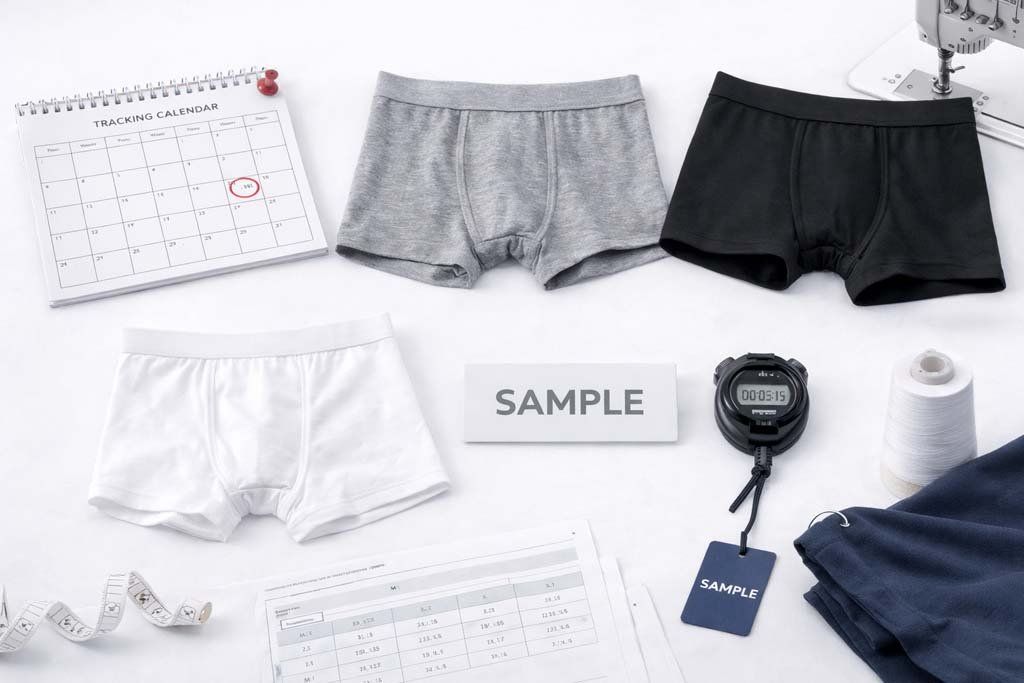
Decisions this guide helps you control
An MOQ is not only a factory rule. It reflects minimum quantities for fabric dyeing or knitting, custom elastic, printing, labels, packaging and effic…
A reference garment or image can communicate a direction, but it does not define the complete product. Before requesting a quotation, prepare the info…
Boxer briefs are a common first style because they serve a broad everyday market, but the correct product depends on the brand’s positioning. Trunks o…
In this guide
- 01What does a 1,000-piece MOQ mean?
- 02Start with a product brief, not only a reference photo
- 03Choose one core silhouette
- 04Select fabric by use case and specification
- 05Plan the waistband and branding together
- 06Develop and test samples before bulk production
- 07Build a realistic color and size assortment
- 08Keep packaging proportional to the launch
- 09How long does bulk production take?
- 10Questions to ask a men’s underwear manufacturer
- 11Frequently asked questions
For most custom programs, Sunin Underwear’s standard starting MOQ is generally 1,000 pieces per style. The workable split depends on the fabric, colors, size range, waistband, packaging and production process. A first order is easier to control when the brand starts with one clear product instead of dividing the quantity across too many variations.
This guide is for founders, product developers and sourcing teams planning a private label men’s underwear collection. It explains what to prepare, where an MOQ becomes restrictive and how to move from an idea to a production-ready specification.
What does a 1,000-piece MOQ mean?
An MOQ is not only a factory rule. It reflects minimum quantities for fabric dyeing or knitting, custom elastic, printing, labels, packaging and efficient production setup. The headline quantity therefore does not mean that every color, size and component can be split without limits.
For example, one style in two colors with a focused size range is usually more practical than one style divided across five colors, two waistband designs and several packaging formats. Final feasibility must be confirmed after the bill of materials and assortment are defined.
| Decision | Lower-complexity first order | What increases complexity |
|---|---|---|
| Styles | One core boxer brief, trunk, boxer or brief | Several patterns and fits in the same launch |
| Fabric | One confirmed fabric and weight | Multiple fabric qualities or custom-developed materials |
| Colors | A small, coordinated color range | Many colors with low quantities per color |
| Waistband | One shared construction and logo treatment | Different elastic structures or logos by color |
| Packaging | One practical retail or e-commerce format | Several boxes, inserts or channel-specific packs |
Start with a product brief, not only a reference photo
A reference garment or image can communicate a direction, but it does not define the complete product. Before requesting a quotation, prepare the information that affects pattern, materials, cost and timing:
- Product type: boxer brief, trunk, boxer, brief or long-leg style
- Target customer and market position
- Preferred fabric composition, weight and performance
- Reference measurements or a size chart
- Pouch, gusset, leg length and seam preferences
- Color and size assortment
- Waistband construction and logo artwork
- Main label, care label and packaging requirements
- Required testing or documentation for the destination market
- Target launch window and delivery destination
A complete tech pack is helpful but not mandatory for an initial discussion. If it is incomplete, the missing specifications should be identified and agreed before sampling and bulk production.
Choose one core silhouette
Boxer briefs are a common first style because they serve a broad everyday market, but the correct product depends on the brand’s positioning. Trunks offer a shorter leg; loose boxers require a different fit and waistband approach; briefs reduce leg coverage; and long-leg styles need more attention to ride-up control and fabric recovery.
The first silhouette should have a clear reason to exist. That reason may be a softer material, a specific pouch shape, a clean everyday fit, an athletic construction or a distinctive waistband. Adding details without a buyer or wearer benefit usually makes development harder without improving the product.
Compare the main silhouettes in our men’s underwear types guide.
Select fabric by use case and specification
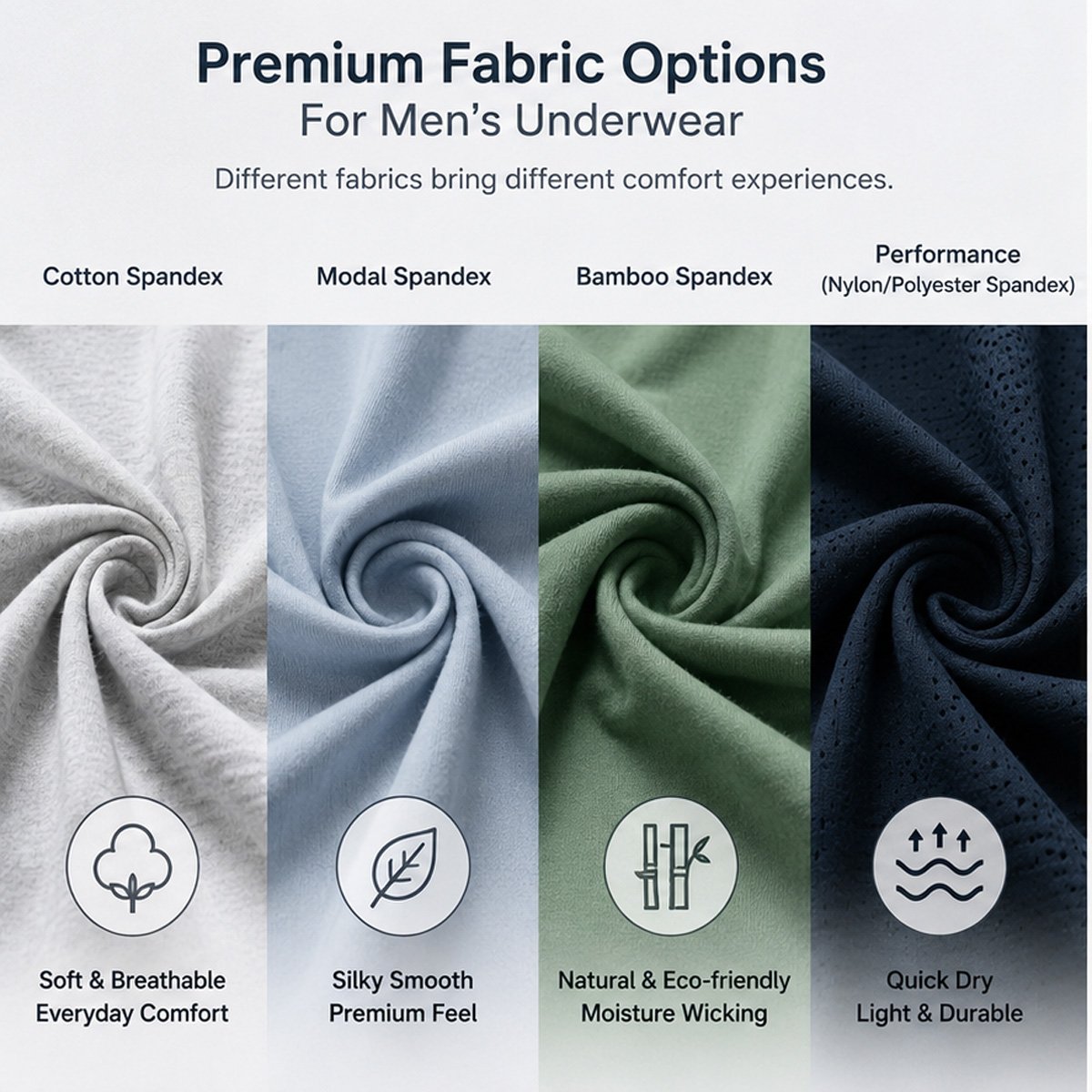
Fabric names alone are not sufficient. Two fabrics with the same fibre composition can differ in weight, knitting, stretch direction, recovery, finishing, shrinkage and hand feel. A sourcing brief should therefore describe the intended performance as well as the fibre content.
- Cotton with elastane: familiar hand feel and suitable for many everyday collections.
- Modal with elastane: selected when a softer, smoother hand feel and fluid drape are priorities.
- Nylon or polyester blends: considered for lightweight, quick-drying or performance-oriented products.
- Mesh or engineered panels: useful only when ventilation zones support the design and construction.
For more detail, use the B2B men’s underwear fabric guide.
Plan the waistband and branding together
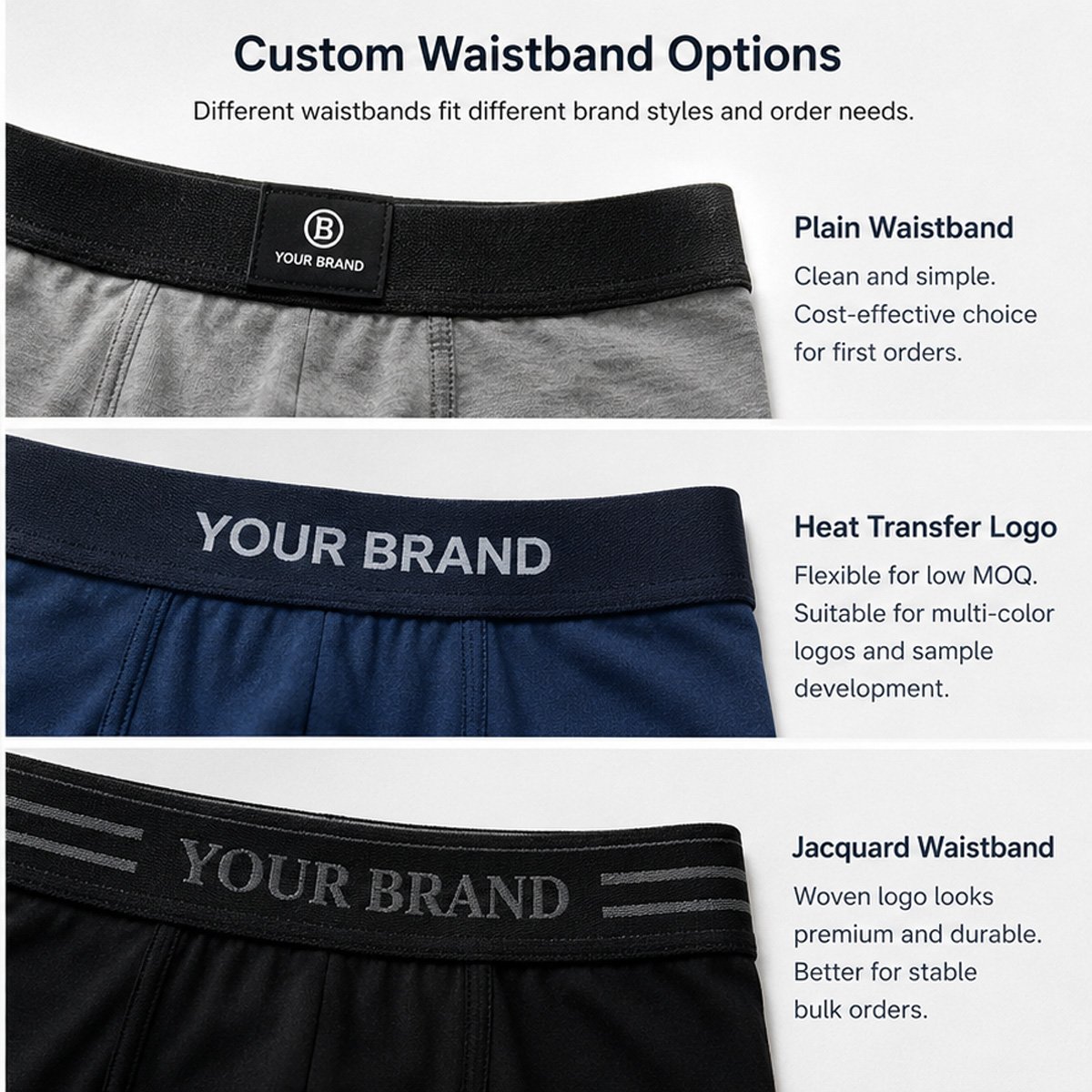
The waistband affects fit, comfort, appearance and component MOQ. A jacquard logo is woven into the elastic and may require development of yarn colors, logo repeat and elastic structure. Printed, heat-transfer or plain elastic options have different visual and production requirements. The right method depends on the artwork, stretch, desired hand feel and order structure.
Do not approve a waistband only from a flat image. Review the logo clarity, repeat, stretch behavior, recovery, edge construction and tension on the actual garment.
Develop and test samples before bulk production
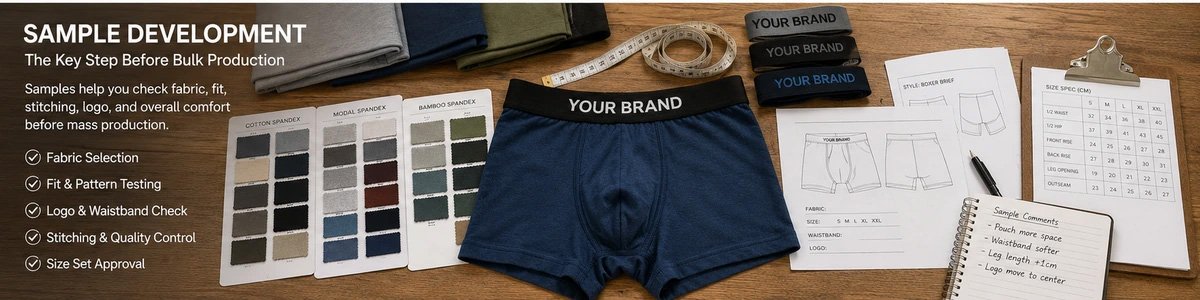
Sampling should answer specific questions. Check the garment on the intended body range and record revisions instead of relying on general comments such as “make it better.”
- Waist, hip, rise, side seam and inseam measurements
- Pouch volume, opening and support
- Gusset shape and seam placement
- Leg opening tension and ride-up behavior
- Fabric stretch, recovery and opacity
- Waistband comfort, curl and recovery
- Stitching appearance and seam extensibility
- Logo position, label comfort and packaging fit
Sample timing depends on material availability, custom components, artwork, pattern work and the number of revision rounds. It should be confirmed for the specific project rather than treated as a fixed public promise.
Build a realistic color and size assortment
A brand should use its customer and channel data to set the size curve. There is no universal size ratio for Europe, the United Kingdom, North America, Australia, New Zealand or the Middle East. For a first collection, avoid pretending that an unsupported generic ratio is market evidence.
Instead, define the intended body measurements, compare them with competitor and channel expectations, fit-test the grading and keep enough quantity in each color-size combination for production. If a proposed assortment creates very small sub-quantities, reduce the number of colors or sizes before adding another style.
Keep packaging proportional to the launch
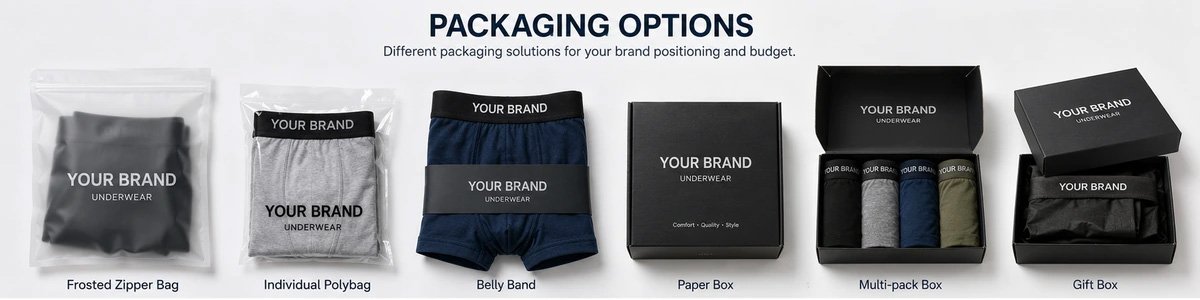
Packaging must protect the garment, carry the required information and suit the sales channel. A simple bag, sleeve or box can be effective when it is consistent with the brand. More components create more artwork, approvals, MOQs and assembly steps.
How long does bulk production take?
For a confirmed custom project, regular bulk production is approximately 60 days. Peak-season orders or projects using custom-developed materials can require approximately 60–75 days. The production period is counted after specifications, approved samples, payment and all production documents are confirmed—not from the first enquiry.
Material lead times, repeated sample revisions, late artwork, color changes or incomplete labeling information can move the start date. Build development, production, inspection and transport into the launch calendar.
Questions to ask a men’s underwear manufacturer
- Which details determine the workable MOQ for this exact design?
- Which materials and components are standard, and which require development?
- What measurements and tolerances will be used?
- How will samples and revisions be approved?
- Which in-line and final quality checks apply to the product?
- Which claims or certifications apply to the factory, and which apply only to a material supplier?
- When does the quoted production lead time begin?
Frequently asked questions
Practical answers for product development and procurement decisions.
Can a new brand start with fewer than 1,000 pieces?
Sunin Underwear’s standard starting MOQ is generally 1,000 pieces per style. A lower quantity is not a standard public offer. Feasibility depends on the actual fabric, color, waistband, packaging and process and must be confirmed case by case.
Does 1,000 pieces mean 1,000 pieces per color?
Not automatically. The workable color split depends on material and process minimums as well as the number of size combinations. Confirm the proposed assortment before relying on a per-color quantity.
Do I need a finished tech pack?
A finished tech pack makes review faster, but a structured reference sample, measurement chart, artwork and product brief can be used to identify missing specifications. Production should not begin until the final documents are confirmed.
Can Sunin Underwear provide dropshipping or Amazon FBA as a standard service?
These are not presented as standard services. The focus is OEM/ODM product development and bulk manufacturing for brands, importers, wholesalers and product teams.
When should I request a quotation?
Request a quotation after you can describe the style, fabric direction, quantity, colors, sizes, branding, packaging and destination. The clearer the specification, the more meaningful the quotation.
Related resources
Planning a men’s underwear project?
Share the style, expected quantity, fabric, colors, sizes, waistband, packaging and destination already known.