
Fit development guide
Underwear Size Grading: How to Build Sizes From an Approved Base Fit
Understand how a controlled base pattern becomes a complete size range—and why waist, rise, leg opening, pouch, waistband and fabric cannot be graded as one simple increment.

Decisions this guide helps you control
A grading plan cannot correct a base pattern that has not been fit-approved.
Waist, rise, leg opening and pouch do not need to move at the same rate.
The same flat measurements can perform differently after material or size-range changes.
In this guide
- 01Start with an approved base size
- 02Separate body and garment measurements
- 03Grade each measurement by function
- 04Treat pouch grading as three-dimensional
- 05Review the fabric context
- 06Grade waistband and garment together
- 07Validate representative sizes
- 08Record the approved grade
- 09Develop sizing for the intended market
A size chart is not the same thing as a grading rule. The chart states what each finished size should measure. Grading defines how the pattern changes from one size to the next. For close-fitting boxer briefs, adding the same number to every measurement can distort support, rise, leg fit and overall proportion.
Underwear size grading: the short answer
Underwear size grading is the controlled expansion and reduction of an approved base pattern—not a percentage resize of the whole garment. Waist, rise, pouch, leg opening, inseam and waistband must be graded by point of measure and checked in the intended fabric. The base fit should be approved first; otherwise every size inherits an unresolved fit issue.
Points of measure and grading risk
| Measurement | What it controls | Common grading risk |
|---|---|---|
| Waist | Body hold, waistband length and overall size progression. | Using garment width without accounting for waistband tension and recovery. |
| Front and back rise | Coverage, body balance and waistband position. | Applying one uniform vertical increment to different body zones. |
| Pouch | Support, projection and movement room. | Scaling width and depth without reviewing seam shape or stretch direction. |
| Leg opening | Comfort, hold and line under clothing. | Ignoring binding, elastic or coverstitch take-up. |
| Inseam | Length and ride-up behavior on boxer brief and long-leg styles. | Changing length without checking leg-opening circumference and fabric recovery. |
Final grade rules depend on the approved base fit, intended market, material behavior and construction. Review the Sunin Underwear Resource Center, boxer brief measurement and fit guide, sample development guide and tech pack guide.
1. Start with an approved base size
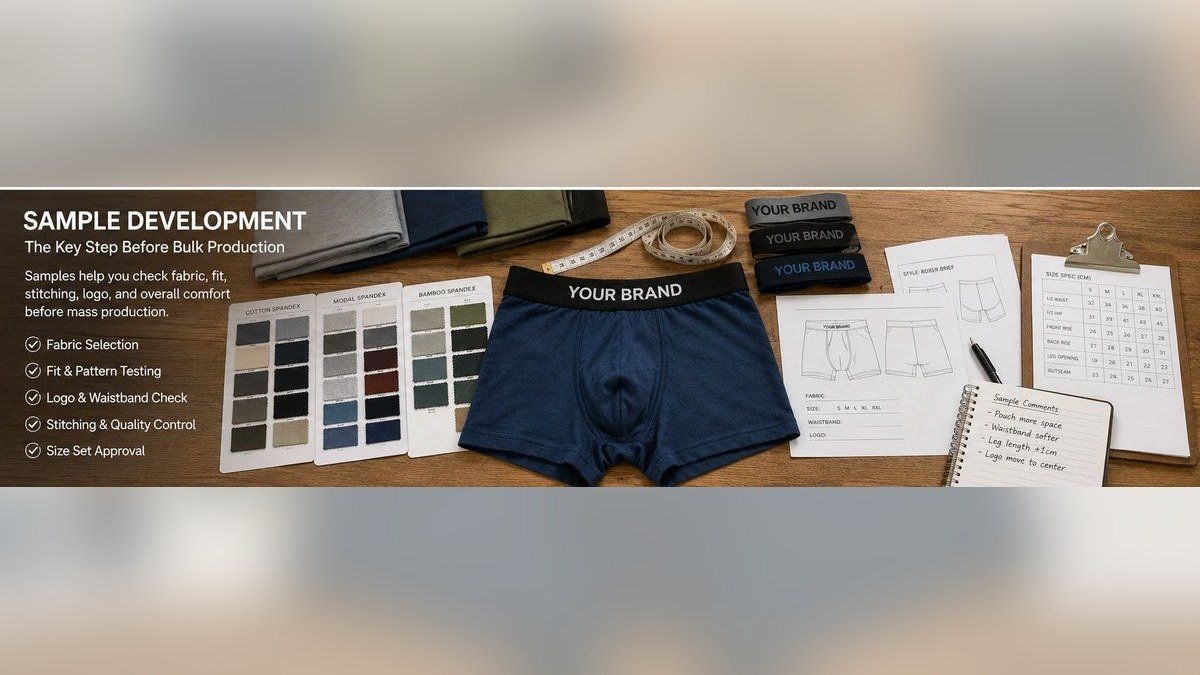
Before expanding to S–XXL or a wider range, establish a reliable base pattern in the intended fabric direction. Confirm waist, front and back rise, inseam, leg opening, pouch, back coverage, waistband tension and the intended silhouette.
The first question is not “What is the XL measurement?” It is “Does the approved base size produce the intended fit?”
2. Separate body measurements from garment measurements
A customer body-waist measurement is not necessarily the same as the relaxed waistband measurement of the garment. Stretch underwear normally uses negative ease and relies on both fabric and elastic behavior.
| Measurement type | What it describes |
|---|---|
| Body measurement | The intended wearer range used by the brand for sizing. |
| Relaxed garment measurement | The product measured flat or around the garment without extension. |
| Stretched measurement | A controlled extension measurement with a defined method. |
| Half measurement | A flat width that must not be confused with circumference. |
Every point of measurement should identify the garment state, direction and method. Ambiguous terminology is a common source of sample and bulk errors.
3. Grade each measurement by function
Different points of measurement control different aspects of fit. Waist, body width, front rise, back rise, inseam, side seam, leg opening and pouch dimensions should follow the approved grading plan—not one universal increment.
Rise and body width should develop without making larger sizes unnecessarily long or smaller sizes too shallow.
Leg opening, pouch and waistband must preserve support, movement and recovery across the range.
4. Treat pouch grading as three-dimensional
The pouch is not only a flat width. Additional volume can depend on width, height, curve, seam shape, panel structure, rise and fabric stretch. Increasing one dimension alone may change appearance without creating the intended support.
Review the front fit on a physical garment and connect pouch changes to the overall pattern. Sunin’s pouch design guide explains why the complete construction matters.
5. Review the fabric context
The same flat dimensions can fit differently when stretch, recovery, GSM, knit or elastane behavior changes. A size chart developed around one material should not be transferred automatically to a materially different fabric.
- Stretch direction
- Recovery after extension
- GSM and density
- Surface finish
- Elastane behavior
- Wash and shrinkage requirements
Use the intended production material in fit approval where feasible. If a substitute fabric is used, mark which fit conclusions remain provisional.
6. Grade the waistband and garment together
The waistband must work with both the intended body range and the garment pattern. Its relaxed length, tension, join and attachment should be reviewed across sizes rather than copied from the base size without adjustment.
A larger waist opening with disproportionate elastic tension can feel tighter than expected; a smaller garment with insufficient recovery can lose support. The waistband-body relationship is part of the fit specification.
7. Validate representative sizes across the range
Where project scope allows, review more than the smallest and largest sizes. Representative checkpoints help reveal whether proportions drift as the pattern becomes smaller or larger.
Common grading problems
- Rise increases too quickly.
- Leg opening becomes disproportionate.
- Pouch volume does not scale with the garment.
- Inseam changes even when the design should remain consistent.
- Waistband tension becomes uneven across sizes.
8. Record the approved grade in the tech pack
The production package should identify the size range, points of measurement, method, values, tolerance and revision. Do not leave the final grade only inside a pattern file without a buyer-readable measurement chart.
Every revision should connect the pattern version, measurement chart, fit approval and intended material.
Review related controls in the men’s underwear tech pack guide and boxer brief measurement guide.
9. Develop sizing for the intended brand and market
Do not assume that “L” means the same thing for every brand, region or customer group. The brand should define its intended body-measurement range, fit direction and labeling, then approve the corresponding garment measurements.
After the base fit, grading, materials and samples are approved, fully customized production is typically planned at approximately 60 calendar days in a normal production period. Peak-period projects may require approximately 60–75 calendar days, subject to actual workload and complexity. Production timing excludes international transport and customer receipt.
Frequently asked questions
What is underwear size grading?
It is the controlled adjustment of an approved base pattern and measurement chart to create the other sizes in a product range.
Should every measurement increase by the same amount?
No. Each measurement performs a different function and should follow the approved grading plan.
Is body waist the same as garment waist?
No. Close-fitting stretch underwear often uses a relaxed garment measurement smaller than the intended body circumference.
Can one size chart be used for every fabric?
Not automatically. Differences in stretch, recovery, weight and construction can change how the same measurements fit.
Should pouch measurements be graded?
Yes, but as part of the complete pattern. Width, depth, curve, rise, seam shape and material behavior interact.
Approve the base fit before multiplying it.
Send the base-size specification, intended size range and material direction so the grading risks can be reviewed before bulk.